 Skip to content

Comparing Flooring Adhesives: Which is Safest for Nursing Homes? 🏥
When it comes to creating a safe environment for elderly residents, nursing home administrators face countless decisions that directly impact the health and wellbeing of their community. One often overlooked but critically important choice involves selecting the right flooring adhesive. While it might seem like a minor detail, the adhesive beneath your facility’s floors can significantly affect indoor air quality, resident safety, and long-term health outcomes. 🌿
Having worked with numerous healthcare facilities over the years, I’ve witnessed firsthand how the wrong adhesive choice can lead to respiratory issues, chemical sensitivities, and even evacuation scenarios. The stakes are simply too high to leave this decision to chance, especially when caring for vulnerable populations who may already have compromised immune systems or respiratory conditions.

Understanding the Unique Challenges of Nursing Home Flooring 🏠
Nursing homes present a perfect storm of flooring challenges that make adhesive selection particularly complex. These facilities experience heavy foot traffic from staff, residents, and visitors, while also dealing with frequent spills, cleaning chemicals, and the need for wheelchair accessibility. The flooring must withstand constant use while maintaining a safe, non-slip surface that won’t contribute to falls – already a leading cause of injury among elderly populations.
What makes this even more challenging is that many residents spend 20-24 hours per day within the facility. Unlike office buildings or retail spaces where people come and go, nursing homes are permanent living environments. This means any off-gassing or chemical emissions from flooring adhesives become a continuous exposure concern rather than a temporary one.
Additionally, many elderly residents have heightened sensitivities to chemicals and fragrances. Their aging respiratory systems may struggle to process airborne contaminants that younger, healthier individuals might tolerate without issue. This vulnerability demands that we choose adhesives with the lowest possible emission profiles.
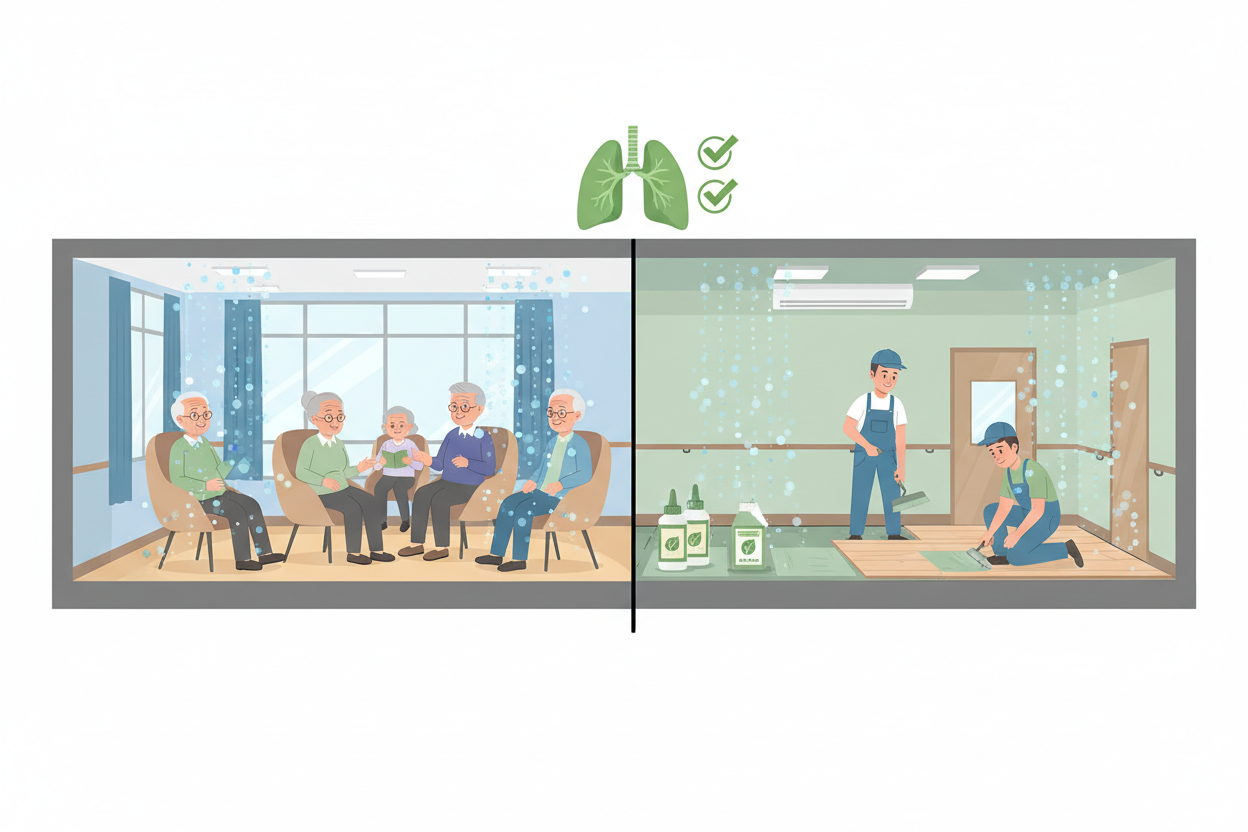
The Health Impact of Traditional Flooring Adhesives ⚠️
Traditional solvent-based adhesives have long been the go-to choice for commercial flooring installations due to their strong bonding properties and relatively low cost. However, these products often contain volatile organic compounds (VOCs) that can create serious health concerns in enclosed environments like nursing homes.
VOCs are chemicals that easily evaporate at room temperature, releasing gases that can irritate eyes, nose, and throat. For elderly residents who may already struggle with conditions like COPD, asthma, or other respiratory ailments, exposure to these compounds can exacerbate symptoms and potentially trigger serious health episodes.
Some of the most concerning chemicals found in traditional adhesives include formaldehyde, toluene, and various petroleum-based solvents. These substances have been linked to headaches, dizziness, respiratory irritation, and in some cases, more serious long-term health effects. The Occupational Safety and Health Administration (OSHA) has established exposure limits for many of these compounds, but even low-level, long-term exposure can be problematic for sensitive individuals.
Beyond immediate health concerns, traditional adhesives often require extended curing times during which strong odors persist. This can necessitate temporary resident relocations or facility closures, creating significant disruption and additional costs for nursing home operators.
Low-VOC and Zero-VOC Adhesive Options: A Safer Alternative 🌱
The flooring industry has responded to health concerns by developing low-VOC and zero-VOC adhesive alternatives that maintain strong bonding properties while dramatically reducing harmful emissions. These products represent a significant advancement in both safety and performance, making them ideal choices for sensitive environments like nursing homes.
Low-VOC adhesives typically contain fewer than 50 grams of VOCs per liter, while zero-VOC products contain less than 5 grams per liter – a massive reduction compared to traditional formulations that might contain 200-400 grams per liter or more. This dramatic decrease in emissions means faster installation times, reduced odors, and most importantly, a healthier indoor environment for residents and staff.
Water-based acrylic adhesives have emerged as particularly popular options in this category. These products cure through water evaporation rather than solvent off-gassing, eliminating many of the harmful compounds associated with traditional adhesives. They also tend to have excellent adhesion properties and can accommodate the thermal expansion and contraction that occurs in large commercial spaces.
Another promising category includes bio-based adhesives derived from renewable resources like soy, corn, or other plant materials. While still relatively new to the market, these products show excellent potential for combining environmental sustainability with health safety, though they may come at a premium cost.
Pressure-Sensitive Adhesives: The Game-Changer for Healthcare Facilities 🔧
Pressure-sensitive adhesives (PSAs) have revolutionized flooring installation in healthcare settings by eliminating the need for wet adhesives entirely. These products come pre-applied to flooring materials or as separate transfer tapes, allowing for immediate installation without mixing, spreading, or curing time.
The primary advantage of PSAs in nursing home environments is the complete elimination of installation-related emissions. There are no wet chemicals to off-gas, no strong odors to dissipate, and no waiting periods before residents can safely occupy the space. This means flooring projects can often be completed during normal operating hours without disrupting resident care or requiring temporary relocations.
PSAs also offer exceptional performance benefits, including immediate bond strength, excellent dimensional stability, and resistance to moisture and temperature fluctuations. Many products in this category can be repositioned during installation, allowing for precise alignment and reducing waste from installation errors.
However, PSAs do require careful surface preparation and aren’t suitable for all flooring types or subfloor conditions. They also tend to be more expensive than traditional wet adhesives, though this cost difference is often offset by reduced installation time and elimination of ventilation requirements.
Mechanical Installation Systems: Adhesive-Free Solutions 🔨
For nursing homes seeking to eliminate adhesive-related concerns entirely, mechanical installation systems offer compelling alternatives. These approaches secure flooring through physical attachment methods rather than chemical bonding, completely removing adhesive emissions from the equation.
Click-lock floating floor systems have gained tremendous popularity in residential applications and are increasingly being adapted for commercial use. These systems rely on interlocking edges that create a unified floor surface without any adhesive contact with the subfloor. When properly installed with appropriate underlayment, floating floors can provide excellent performance while maintaining the flexibility to access subfloor utilities if needed.
Direct-nail or staple systems work well for certain flooring types, particularly engineered wood products. While these methods do create some installation noise, they eliminate chemical concerns and provide permanent, reliable attachment. However, they’re not suitable for all subfloor types and may not work well in areas with high moisture exposure.
Raised floor systems represent another mechanical approach that’s particularly valuable in nursing homes with extensive electrical and data infrastructure. These systems create an accessible plenum space beneath the finished floor while providing excellent performance characteristics. Though more expensive initially, they can significantly reduce long-term maintenance costs and provide flexibility for future renovations.
Making the Right Choice: Factors to Consider for Your Facility 🤔
Selecting the optimal adhesive system for your nursing home requires balancing multiple factors beyond just health and safety considerations. While resident wellbeing should always be the primary concern, practical considerations like budget, installation timeline, and long-term maintenance requirements all play important roles in the decision-making process.
Budget considerations extend beyond the initial adhesive cost to include installation labor, potential resident relocation expenses, and long-term performance factors. While low-VOC and mechanical systems often carry higher upfront costs, they frequently provide better value when considering the total cost of ownership, including reduced health risks and potential liability concerns.
Installation timeline can be crucial in nursing home environments where resident displacement must be minimized. PSAs and mechanical systems often allow for faster installations with immediate occupancy, while traditional adhesives may require extended ventilation periods that disrupt facility operations.
The specific flooring material you’re installing will also influence adhesive selection. Luxury vinyl tile (LVT) works well with most adhesive types, while natural materials like cork or bamboo may require specialized products. Your flooring manufacturer’s recommendations should always be considered, as using non-approved adhesives can void product warranties.
Environmental conditions within your facility matter too. Areas with high humidity, temperature fluctuations, or frequent cleaning with harsh chemicals need adhesives that can withstand these challenges without failing or releasing additional emissions over time.
Implementation Best Practices for Nursing Home Flooring Projects 📋
Even with the safest adhesive selection, proper implementation remains crucial for protecting resident health and ensuring project success. Developing a comprehensive installation plan that addresses ventilation, resident protection, and quality control can make the difference between a smooth renovation and a facility emergency.
Timing considerations should prioritize resident safety above all else. Even with low-emission products, scheduling installations during periods of reduced occupancy or when residents can be temporarily relocated to other areas of the facility helps minimize exposure risks. Many nursing homes find success with phased installations that allow residents to remain in unaffected areas while work progresses.
Ventilation planning becomes critical even with safer adhesive choices. Increasing fresh air exchange rates during and immediately after installation helps ensure any residual emissions are quickly removed from the living environment. Portable air filtration units with activated carbon filters can provide additional protection in areas where natural ventilation is limited.
Staff training ensures that installation teams understand the unique requirements of healthcare environments. This includes protocols for working around medical equipment, maintaining infection control standards, and recognizing signs of resident distress that might indicate sensitivity reactions.
Post-installation monitoring should include air quality testing when possible, particularly if residents or staff report any unusual odors or symptoms. Having a plan for addressing potential issues quickly demonstrates commitment to resident safety and can prevent minor concerns from becoming major problems.
Conclusion: Prioritizing Safety Without Compromising Performance 🎯
The choice of flooring adhesive in nursing homes represents far more than a simple construction decision – it’s a commitment to the health and wellbeing of some of our most vulnerable community members. While traditional solvent-based adhesives may offer familiarity and lower upfront costs, the potential health risks they pose in enclosed healthcare environments make them increasingly difficult to justify.
Low-VOC and zero-VOC adhesives, pressure-sensitive systems, and mechanical installation methods all offer viable pathways to creating safer indoor environments without sacrificing performance or durability. The key lies in understanding your facility’s specific needs, resident population, and operational constraints to select the approach that best balances safety, performance, and practical considerations.
As we continue to learn more about the impacts of indoor air quality on health outcomes, particularly among elderly populations, the importance of these decisions only grows. By prioritizing resident safety in flooring adhesive selection, nursing home operators can create healthier environments that support better quality of life and potentially reduce healthcare costs related to respiratory and chemical sensitivity issues.
The investment in safer adhesive systems pays dividends not just in resident health, but also in staff satisfaction, regulatory compliance, and the peace of mind that comes from knowing you’ve made choices that truly put resident wellbeing first. In an industry where trust and care are paramount, these seemingly small decisions can make a profound difference in the lives of those we serve. 💚
Call Us Now!